
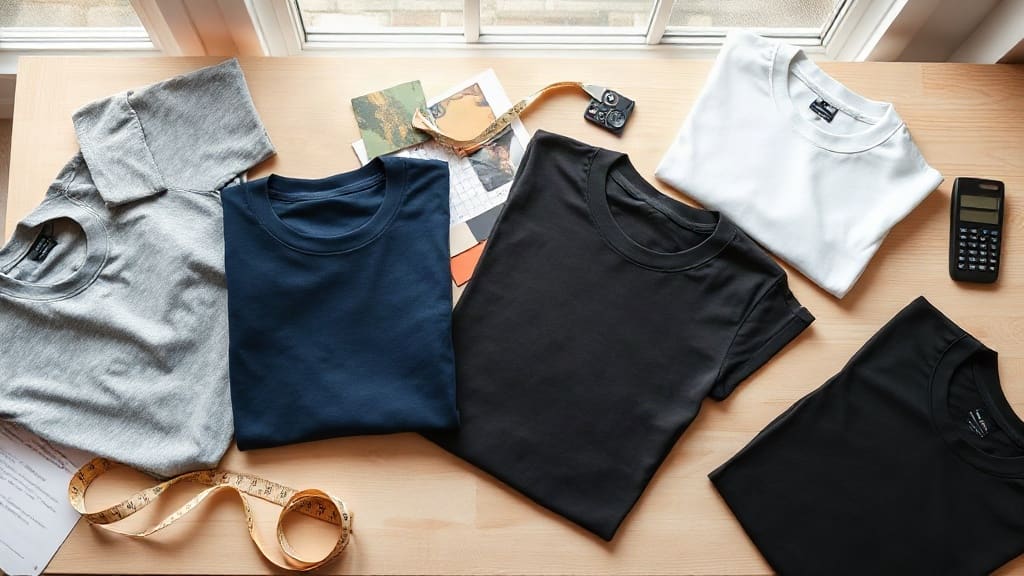
When you invest in custom premium shirts, every dollar counts. Whether you're outfitting a team, launching merchandise, or creating uniforms for a growing business, understanding CPS (cost per shirt) is essential. It's not just about the sticker price—it's about the true value you get from each garment. In this guide, we'll break down what CPS really means, how to calculate it, and how to make smart choices that elevate your brand without breaking the bank.
What Is CPS and Why It Matters for Custom Premium Shirts
CPS stands for cost per shirt. At its simplest, it's the total amount you spend divided by the number of shirts you receive. But in the world of custom premium shirts, the calculation goes deeper. It includes the base cost of the garment, decoration charges (like screen printing or embroidery), setup fees, shipping, and even the time your team spends managing the order. When you factor in all these elements, you get a realistic picture of your true CPS.
Why should you care? Because CPS directly impacts your bottom line. If you're buying shirts to sell, a lower CPS means higher margins. If you're buying for internal use, a lower CPS means more budget for other initiatives. But here's the catch: chasing the lowest CPS can lead to cheap shirts that fade, shrink, or feel uncomfortable—ultimately costing you more in replacements and damaged brand perception. The goal is to optimize CPS without compromising on the premium quality your brand deserves.
How to Calculate Your True CPS
Many buyers only look at the unit price, but that's just the beginning. To get an accurate CPS, follow these steps:
- Add up all direct costs: garment cost, decoration, setup fees, and shipping.
- Include indirect costs: design time, order management, and any rush charges.
- Divide by the number of usable shirts: account for potential misprints or sizing issues.
For example, if you order 100 shirts at $10 each, with a $50 setup fee and $100 shipping, your total cost is $1,150. If 5 shirts are defective, you have 95 usable shirts, making your true CPS $12.11—not $10. This number is your real benchmark for comparison.
Factors That Influence CPS in Custom Premium Shirts
Several variables can make your CPS go up or down. Understanding them helps you make strategic decisions.
Fabric and Construction
Premium shirts often use combed ringspun cotton, tri-blends, or performance fabrics. These materials feel softer, last longer, and hold prints better, but they cost more. A basic cotton tee might land you a $6 CPS, while a premium tri-blend could be $12 or more. The key is to match the fabric to the shirt's purpose. For retail merch, premium fabrics justify a higher price point. For giveaways, a mid-tier option might be smarter.
Decoration Method
Screen printing is cost-effective for large orders, often adding $1–$3 per shirt. Embroidery looks upscale but can add $5–$10 per shirt, especially for complex logos. Direct-to-garment (DTG) printing has no setup fees but a higher per-unit cost, making it ideal for small batches. Heat transfer and sublimation are other options, each with its own CPS implications. Choose based on your design, quantity, and desired look.
Order Quantity
Economies of scale are real. Most suppliers offer price breaks at 50, 100, 250, and 500 units. A shirt that costs $8 at 50 pieces might drop to $5 at 500 pieces. However, don't over-order just to lower CPS—unsold inventory ties up cash and may become dead stock. Forecast demand accurately.
Supplier and Location
Domestic suppliers often have higher base costs but faster turnaround and lower shipping. Overseas suppliers can offer lower unit prices but come with longer lead times, customs, and quality risks. Calculate the total landed cost to compare fairly. Sometimes a slightly higher CPS from a local supplier is worth it for reliability and speed.
Balancing CPS with Premium Quality
The sweet spot is finding a CPS that supports your goals without sacrificing the premium feel that sets your brand apart. Here's how to strike that balance:
- Define your non-negotiables: Is it softness? Durability? Color accuracy? Prioritize the features that matter most to your audience.
- Test before scaling: Order samples to evaluate quality and get a real sense of CPS at small scale before committing to a large run.
- Negotiate strategically: Ask about price breaks, waived setup fees for repeat orders, or bundled services. Building a relationship with your supplier can lead to better terms.
- Consider the lifetime value: A shirt that lasts two years has a lower effective CPS than a cheap one that lasts six months. Factor in replacement costs.
Common Mistakes That Inflate CPS
Even experienced buyers can fall into traps that drive up CPS. Watch out for these:
- Ignoring setup fees: These one-time charges can add hundreds to your total, especially for multi-color designs.
- Choosing the wrong decoration: Using embroidery on a lightweight tee can distort the fabric, leading to waste.
- Ordering too few or too many: Small orders miss price breaks; large orders risk unsold stock.
- Overlooking shipping and duties: These can add 10–20% to your landed cost.
- Not accounting for defects: Always budget for a small percentage of misprints or damaged goods.
How Smart Blanks USA Helps You Optimize CPS
At Smart Blanks USA, we specialize in premium blank apparel that serves as the perfect canvas for your custom designs. Our curated selection includes combed ringspun cotton, tri-blends, and performance fabrics from trusted brands. By offering high-quality blanks at competitive prices, we help you achieve a favorable CPS without compromising on the premium feel your customers expect. Plus, our team can guide you on decoration methods and order quantities to further refine your strategy. Whether you're a small startup or an established brand, we're here to support your growth.
Frequently Asked Questions About CPS and Custom Premium Shirts
What is a good CPS for custom premium shirts?
A good CPS depends on your purpose. For retail, aim for a CPS that allows a 2.5x to 3x markup. For uniforms or giveaways, focus on balancing quality and budget. Generally, a CPS between $8 and $15 is reasonable for premium shirts with decoration, but always calculate your true cost.
How can I lower my CPS without sacrificing quality?
Order in larger quantities to hit price breaks, choose a decoration method that suits your design (screen printing for bold graphics, embroidery for logos), and work with a supplier who offers premium blanks at fair prices. Also, minimize waste by ordering accurate sizes.
Does CPS include shipping and taxes?
For an accurate CPS, include all costs: garment, decoration, setup, shipping, and taxes. Some suppliers quote a unit price that excludes these, so always ask for a landed cost breakdown.
Why do premium shirts have a higher CPS?
Premium shirts use better fabrics, construction, and often ethical manufacturing, which costs more. However, they also last longer, feel better, and enhance brand perception, making them worth the investment for many businesses.
Can I get a lower CPS on small orders?
Small orders typically have a higher CPS due to setup fees and lack of volume discounts. To reduce CPS, consider digital printing (no setup fees) or join a group order with other departments or businesses.