
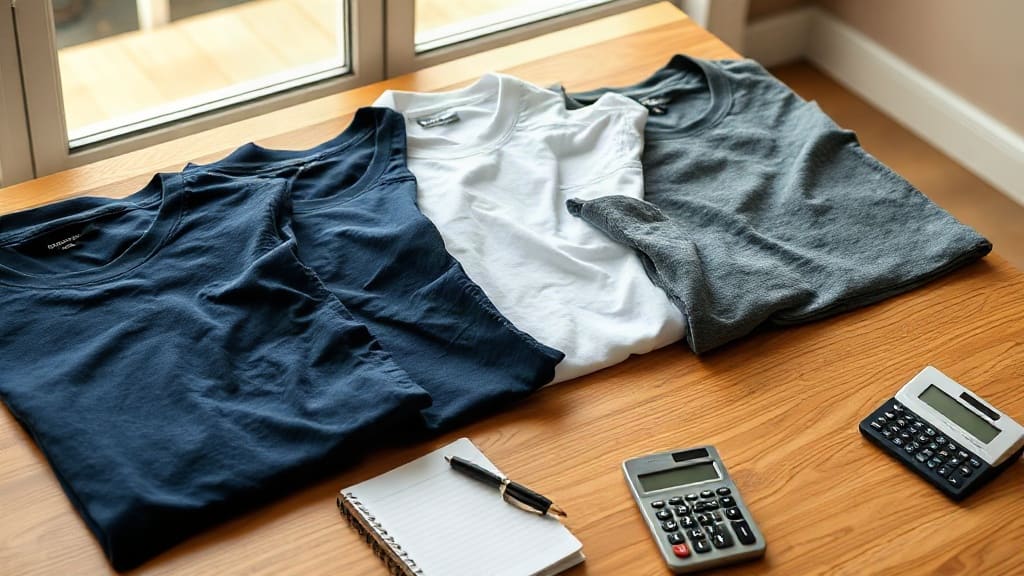
You've probably seen the term CPS floating around in pricing discussions, but when it comes to custom premium shirts, it takes on a whole new meaning. CPS, or cost per shirt, is the single most important number to track if you want to get the best value for your money. Whether you're ordering for a corporate event, a sports team, or a retail line, understanding CPS helps you make smarter decisions. In this guide, we'll break down what CPS really means for custom premium shirts, how to calculate it, and proven strategies to lower it without cutting corners on quality.
What Exactly Is CPS in Custom Apparel?
CPS stands for cost per shirt. It's the total amount you pay for an order divided by the number of shirts you receive. But here's the catch: many buyers confuse CPS with the unit price. They're not the same. The unit price is what the supplier charges per shirt, while CPS includes all additional costs: setup fees, screen charges, shipping, taxes, and even design fees. When you calculate CPS correctly, you get a true picture of your investment.
For example, if you order 50 shirts at $10 each and pay a $50 setup fee plus $20 shipping, your total cost is $570. Divide that by 50, and your CPS is $11.40. That's a 14% increase over the unit price. Ignoring these extras can wreck your budget, especially on large orders.
Why CPS Matters for Premium Shirts
Premium shirts are an investment. They use higher-quality fabrics, better stitching, and often come from ethical manufacturing. When you're paying a premium, you want to ensure every dollar counts. Tracking CPS allows you to compare quotes from different suppliers on an apples-to-apples basis. A supplier with a lower unit price might actually have a higher CPS once fees are added. Conversely, a supplier with a slightly higher unit price could offer a better overall deal if they waive setup charges or provide free shipping.
How to Calculate CPS Accurately
Calculating CPS is straightforward, but you need to account for every cost. Here's a step-by-step method:
- List all direct costs: This includes the base price per shirt, any additional charges for sizes (e.g., XXL), and color upgrades.
- Add one-time fees: Setup fees, screen charges, digitizing fees for embroidery, and design fees.
- Include shipping and taxes: Don't forget these, as they can vary significantly based on order size and destination.
- Sum everything up: This is your total order cost.
- Divide by the number of shirts: The result is your CPS.
Let's say you order 100 premium polo shirts. The unit price is $15, but you need a 3-color logo on the left chest. The screen setup is $75, and shipping is $50. Total cost = (100 x $15) + $75 + $50 = $1,625. CPS = $16.25. Now you have a clear number to compare with other quotes.
Common Mistakes That Inflate CPS
Many buyers inadvertently raise their CPS by making avoidable errors. Here are a few:
- Ordering too few shirts: Setup fees are spread over fewer units, increasing CPS. Always ask about price breaks at higher quantities.
- Choosing complex designs: More colors mean more screens and higher setup costs. Simplify where possible.
- Ignoring shipping: Rush orders or international shipping can add significantly to CPS. Plan ahead to use standard shipping.
- Not asking for a detailed quote: Some suppliers hide fees until the final invoice. Always request an itemized quote.
Strategies to Lower CPS Without Sacrificing Quality
Lowering CPS doesn't mean settling for cheap shirts. It's about optimizing your order to get the best value. Here are proven tactics:
1. Increase Order Quantity
This is the most effective way to reduce CPS. Most suppliers offer tiered pricing, where the unit price drops as quantity increases. Setup fees are also spread over more shirts. For instance, ordering 250 shirts instead of 50 can cut your CPS by 20-30%. If you anticipate future needs, consider ordering in bulk and storing extras.
2. Simplify Your Design
Each color in your design requires a separate screen, and each screen adds a setup fee. By reducing the number of colors, you can significantly lower setup costs. Also, consider placement: a single-color logo on the chest is cheaper than a multi-color design across the back. If you're set on a complex design, ask if digital printing or heat transfer is more cost-effective for smaller runs.
3. Negotiate Setup Fees
Setup fees are often negotiable, especially for large orders or repeat customers. Don't be afraid to ask. Some suppliers waive setup fees entirely if you commit to a certain volume. If you're ordering multiple times, ask about keeping screens on file to avoid future setup charges.
4. Choose Standard Shipping
Rush shipping can double your shipping costs, directly impacting CPS. Plan your order well in advance to use ground shipping. If you need shirts for a specific event, work backward from the date to determine the latest possible order date that still allows standard shipping.
5. Consider Alternative Decoration Methods
Embroidery is premium but can be costly for complex logos. Screen printing is cost-effective for large orders with simple designs. Digital printing has no setup fees and is great for small orders with many colors. Evaluate which method gives you the best balance of quality and cost for your specific project.
Real-World Example: CPS in Action
Let's walk through a scenario. A local gym wants to order 75 custom premium performance shirts for its staff. They get two quotes:
- Supplier A: $12 per shirt, $50 setup fee, $30 shipping. Total = (75 x $12) + $50 + $30 = $980. CPS = $13.07.
- Supplier B: $11 per shirt, $100 setup fee, free shipping. Total = (75 x $11) + $100 = $925. CPS = $12.33.
Although Supplier B has a higher setup fee, the free shipping and lower unit price result in a lower CPS. This shows why looking beyond the unit price is crucial.
Frequently Asked Questions About CPS and Custom Premium Shirts
What does CPS stand for in custom apparel?
CPS stands for cost per shirt. It's the total cost of your order divided by the number of shirts, giving you the true average cost per item.
How can I reduce CPS on small orders?
For small orders, focus on minimizing setup fees. Choose designs with fewer colors, opt for digital printing (no screens), and ask if setup fees can be waived. Sometimes ordering a few extra shirts to reach a price break can lower your CPS.
Is a lower CPS always better?
Not necessarily. A lower CPS might mean lower quality shirts or rushed production. Always balance cost with quality and reliability. Premium shirts may have a higher CPS but offer better durability and comfort, which can be more cost-effective in the long run.
How do I compare CPS between suppliers?
Request itemized quotes from each supplier, including all fees. Calculate CPS for each using the same order specifications. Also consider factors like production time, customer service, and reputation.
Does CPS include taxes?
Yes, for an accurate CPS, include any applicable taxes. However, some businesses may exclude taxes for internal budgeting. Be consistent in your calculations.
Understanding and optimizing CPS is key to getting the most value from your custom premium shirt orders. By following the strategies outlined here, you can reduce costs without compromising on the quality that makes premium shirts worth it. Remember, the goal isn't just a low price, but the best overall value for your investment.